The 7 Different Types of Art, Explained
People keep asking which seven things count as "art," so here's the honest version: where the list comes from, what belongs on it, and why painting is only one slice.
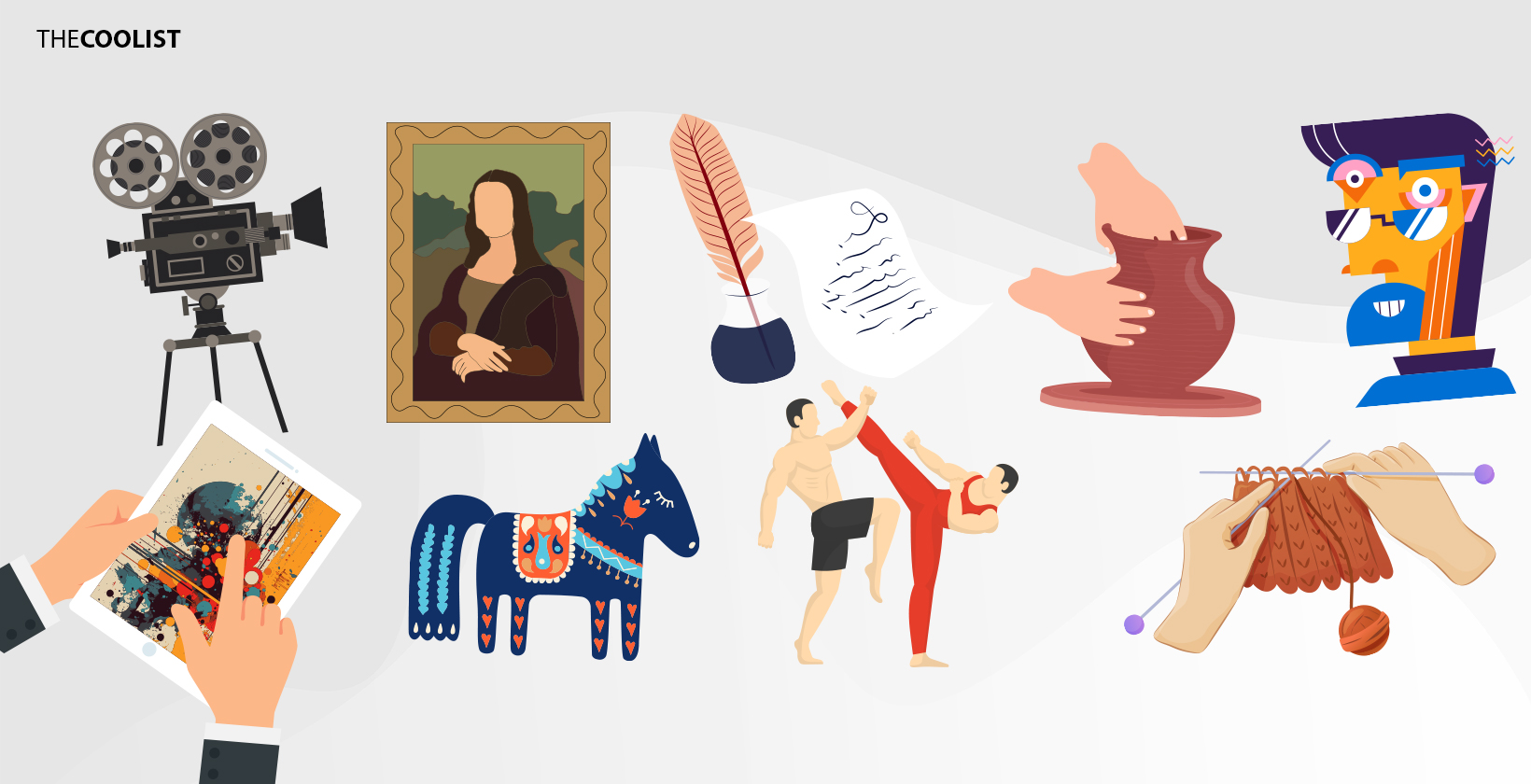
The phrase "the 7 different types of art" gets searched thousands of times a month, and most pages answering it just hand you a list and walk away. The list itself is worth knowing. The story behind it is more useful, because once you understand where the number seven comes from, you stop treating it as gospel and start seeing how the categories actually work in practice.
Short version up top, then the detail. The seven types most commonly cited are painting, sculpture, architecture, literature, music, performance (theater and dance), and cinema. That's the version you'll find repeated across art education sites, and it traces back to a real historical idea, not a random listicle.
where the number seven actually comes from
The "seven arts" idea is old, and it shifted over time. In the medieval period, the seven liberal arts meant grammar, rhetoric, logic, arithmetic, geometry, music, and astronomy. Those were fields of study, not what we now call fine art. Wikipedia's entry on the arts walks through how the modern grouping replaced that older scheme.
The version most people mean today comes from the early 20th century. The Italian critic Ricciotto Canudo wrote a piece in 1911 called "The Birth of the Sixth Art," arguing that cinema deserved a place alongside the existing five (architecture, sculpture, painting, music, poetry). He later folded in dance and called film the seventh art. That phrase, "le septième art," stuck so hard that the French still use it as a casual synonym for movies.
So the canonical seven, in the order they're usually given:
- painting
- sculpture
- architecture
- literature (often listed as poetry)
- music
- performance (theater and dance)
- cinema
If you've seen a list that puts them in a different sequence, that's normal. There's no official ranking. The "in order" searches usually want chronological order of invention, which would run something like architecture and sculpture first, then painting, literature, and music, with theater following, and cinema arriving last around 1895.
the 7 types, one by one, with real examples
1. painting
The one people picture first. Painting is pigment applied to a flat surface, and it ranges from cave walls to oil on canvas to acrylic on a skateboard deck. Think Vermeer's "Girl with a Pearl Earring," Rothko's color fields, or a Diego Rivera mural the size of a wall. Painting is where most people start when they want to understand composition and color, and it's worth learning the basic relationships there, like the 60 30 10 rule for balancing color in a piece.
2. sculpture
Three-dimensional art you can walk around. Carving (taking material away), modeling (building it up in clay), casting (pouring bronze or resin into a mold), and assemblage (bolting found objects together) all count. Michelangelo's "David" is 17 feet of carved marble. A Louise Bourgeois spider made of cast bronze is sculpture too, and so is a Calder mobile that moves in the air. The medium is wide open.
3. architecture
This is the one people forget belongs here, but it's been on the list since the beginning. Architecture is the art of designed space: cathedrals, houses, bridges, the Sydney Opera House. It earns its spot because at its best it's not just engineering. Gaudí's Sagrada Família in Barcelona has been under construction since 1882 and treats stone like something growing out of the ground.
4. literature
Words arranged for effect. Poetry, novels, plays as written texts, even essays. Some lists narrow this to poetry because that's the form Canudo named, but the broader reading holds up. A sonnet and a 900-page novel are both doing the thing literature does, which is build meaning and feeling out of language alone.
5. music
Organized sound across time. A Bach fugue, a Miles Davis record, a three-chord punk song. Music is the most abstract of the seven in one sense, because it points to nothing outside itself, yet almost everyone responds to it without training. That gap between "abstract" and "moves me anyway" is the same puzzle you hit with painting, which is part of why abstract art counts as art at all.
6. performance (theater and dance)
Art made with the body, live, in real time. A staging of "Hamlet," a Pina Bausch dance piece, a Marina Abramović performance where she sat silent across a table from strangers for hours. The defining trait is that it happens once and then it's gone, which makes it different from a painting that hangs on a wall for centuries. Documentation exists, but the thing itself is the moment.
7. cinema
The newest member, and the one Canudo argued combined all the others: it has painting's image, sculpture's form, architecture's space, literature's story, music's score, and performance's acting. Film borrows from everything before it and arranges those borrowings in moving pictures. Kubrick's "2001," a Studio Ghibli film, a documentary shot on a phone. All cinema.
Quick note on the related "10 types" searches: those longer lists just split the seven into finer categories. Photography, printmaking, ceramics, and graphic design get pulled out as standalone forms. They're all real art forms. They're usually treated as branches of the original seven rather than separate trunks.
the 7 elements of art are a different thing
One of the most common mix-ups in these searches: people ask about the 7 types of art and the 7 elements of art as if they're the same question. They're not.
The elements of art are the building blocks inside any visual artwork, the raw vocabulary an artist uses. The standard set is line, shape, form, space, color, value, and texture. (Some teachers list eight by separating value from color.) You'd use these to analyze a single painting, not to sort all of human creativity into bins.
So if a teacher asks for the seven elements, they want line, shape, form, value, space, color, texture. If someone asks for the seven types, they want the painting-sculpture-architecture list above. The Tate's glossary is a reliable place to check definitions for either; their art terms section defines things plainly without the jargon. Color alone is deep enough to spend a while on, which is why the color wheel still trips up working artists.
"7 styles" is yet another question
People also search "7 art styles," and again that's separate. A style is a recognizable way of making art, usually tied to a movement or period. There's no fixed seven, but a common starter set includes:
- Realism, painting things as they appear
- Impressionism, loose brushwork chasing light, like Monet
- Expressionism, distortion to convey emotion, like Munch's "The Scream"
- Cubism, fractured multiple viewpoints, Picasso and Braque
- Surrealism, dream logic, Dalí and Magritte
- Abstract, no representation at all
- Pop art, mass-culture imagery, Warhol's soup cans
Type, element, and style are three different filing systems. Cinema is a type. A film noir is a style. Lighting and shadow are elements within it. If you keep those three straight you'll never be confused by these search results again, and the history of how styles develop is its own rabbit hole worth following, since art movements still shape how we see.
do the categories still hold up?
Here's where I'll plant a flag. The seven-types model is a useful map, but it was drawn before most of the art you actually encounter existed. Canudo couldn't have predicted video games, generative work made with code, sound installations, or net art that lives only in a browser. The categories don't break, exactly, but they bleed into each other constantly.
Plenty of contemporary work refuses to sit in one box. A James Turrell light installation is architecture, sculpture, and painting in the same breath. A video piece projected across a building facade is cinema and architecture at once. If you follow contemporary art coverage, you see this every week. The art and design magazine Colossal regularly features pieces that combine sculpture, animation, and engineering in ways the 1911 list has no slot for, and that's the rule now rather than the exception.
This isn't a reason to throw the categories out. It's a reason to hold them loosely. The seven types tell you what people meant by "art" for most of recorded history. They don't draw a fence around what art can be.
what about the "3 types of art" you've also seen
Another search variant worth clearing up. "The 3 types of art" usually refers to a much broader division: visual art, performing art, and literary art. That's the wide-angle view that contains the seven inside it.
- Visual arts: painting, sculpture, architecture, plus photography and printmaking
- Performing arts: music, theater, dance, and arguably film
- Literary arts: poetry, fiction, drama as written text
So the three and the seven aren't competing answers. The three are categories, the seven are members. Some sources also draw a line between fine art (made to be looked at and contemplated) and applied or decorative art (made to be used), which is where furniture, textiles, and ceramics tend to live. The Metropolitan Museum's Heilbrunn Timeline of Art History is a good free resource if you want to see how a major museum organizes thousands of objects across all these lines.
how to actually use this
If you came here for a test answer, you've got it: painting, sculpture, architecture, literature, music, performance, cinema. Write those seven and you're correct by any standard rubric.
If you came here because you genuinely want to understand art better, the more interesting move is to pick one type you ignore and pay attention to it for a month. Most people who love painting never really watch how a film is shot. Most film fans never stand in a building and notice how the space makes them feel. The categories were invented partly to argue that all of these deserve the same serious attention. That argument still works.
Next time you're in a gallery and can't tell which box something belongs in, that confusion is the point. The work is doing something the chart didn't predict, and noticing that is a better skill than memorizing the list. There's no single correct sequence to look in, which is its own worthwhile question to sit with: whether there's a right way to look at art at all.