The 10 Best Art Museums in the World
Every "best museums" list is an argument, not a fact. Here's mine, built on collection depth, crowd reality, and which works you'll remember a decade later.
Ask ten curators for the ten best art museums and you'll get eleven answers. Ranking museums is a strange game because a place with 8 million objects isn't automatically better than a single perfect room. So before I give you the list, here's the standard I used: depth and range of the permanent collection, how many genuinely first-rank works hang there, the building itself, and whether a normal person can actually have a good day inside without being trampled.
I've left out natural history and science museums on purpose. This is about painting, sculpture, and the objects we make to mean something. If you want the broader argument about why these places matter at all, I wrote about the relationship between art and culture separately.
1. The Louvre, Paris
It has to be first, and not only because of the woman behind the glass. The Louvre holds around 35,000 objects on display out of a collection estimated near 615,000, and it drew about 8.7 million visitors in 2024, more than any other art museum on earth. That scale is both its glory and its problem.
The Mona Lisa room is a scrum. Get there at opening, look at her for ninety seconds, then walk away into rooms most people skip: the French neoclassical galleries with David's enormous "Coronation of Napoleon," the Dutch wing where Vermeer's "The Lacemaker" sits quietly, the Near Eastern antiquities with the Code of Hammurabi carved into black basalt. The "Winged Victory of Samothrace" at the top of the Daru staircase is the single most dramatic placement of a sculpture anywhere. You will not see it all. Nobody does.
2. The Metropolitan Museum of Art, New York
The Met is the most complete encyclopedic museum in the Western Hemisphere, with a collection of more than 1.5 million works spanning 5,000 years. Where the Louvre tilts heavily European, the Met genuinely covers the planet: a full Egyptian temple (the Temple of Dendur, reassembled inside a glass-walled hall), Han dynasty ceramics, Benin bronzes, American period rooms, and one of the strongest European painting collections outside Europe.
Practical tip that locals know: the Met is two buildings. The main Fifth Avenue palace handles everything historical. The Met has also operated separate spaces for modern and contemporary work over the years, so check what's on before you go. For the Western canon under one roof, this is hard to beat.
3. The Vatican Museums, Vatican City
You're walking through a working religious state to reach the art, which colors the whole experience. The Vatican Museums hold roughly 70,000 works, about 20,000 on display, accumulated by popes over five centuries. Most visitors are there for one ceiling.
The Sistine Chapel earns the hype. Michelangelo painted the ceiling between 1508 and 1512, then returned decades later for "The Last Judgment" on the altar wall. What people forget: the Raphael Rooms a few corridors earlier, especially "The School of Athens," are arguably the more sophisticated paintings. The Vatican's problem is flow. Around 5 million people funnel through annually along largely fixed routes, so the early-morning or special evening tickets are worth the premium.
4. The Prado, Madrid
If the Louvre is about breadth, the Prado is about concentrated genius. It's a painter's museum. The Spanish holdings are unmatched: roughly 50 works by Velázquez, including "Las Meninas," which Picasso copied 58 times trying to understand it. Then Goya, from the bright tapestry cartoons to the Black Paintings he made on his own walls late in life, dark and half-mad and unlike anything else from the period.
Add the best Bosch collection anywhere ("The Garden of Earthly Delights" alone justifies the trip) and a deep run of Titian, and you have a museum where almost every painting is a keeper. It's also walkable in a single focused day, which the giants on this list are not.
5. The British Museum, London
The most contested place on this list, and I include it knowing that. The British Museum holds around 8 million objects, the largest collection of its kind, and admission is free. The Rosetta Stone, the Parthenon (Elgin) Marbles, Assyrian lion-hunt reliefs, the Sutton Hoo helmet: these are objects that changed how we read the ancient world.
They're also objects whose ownership is genuinely disputed. Greece has asked for the Parthenon sculptures back for decades, and Nigeria continues to press for the Benin bronzes. You can love the collection and still think a lot of it shouldn't be there. Go with that tension in mind rather than pretending it isn't real.
6. The Hermitage, Saint Petersburg
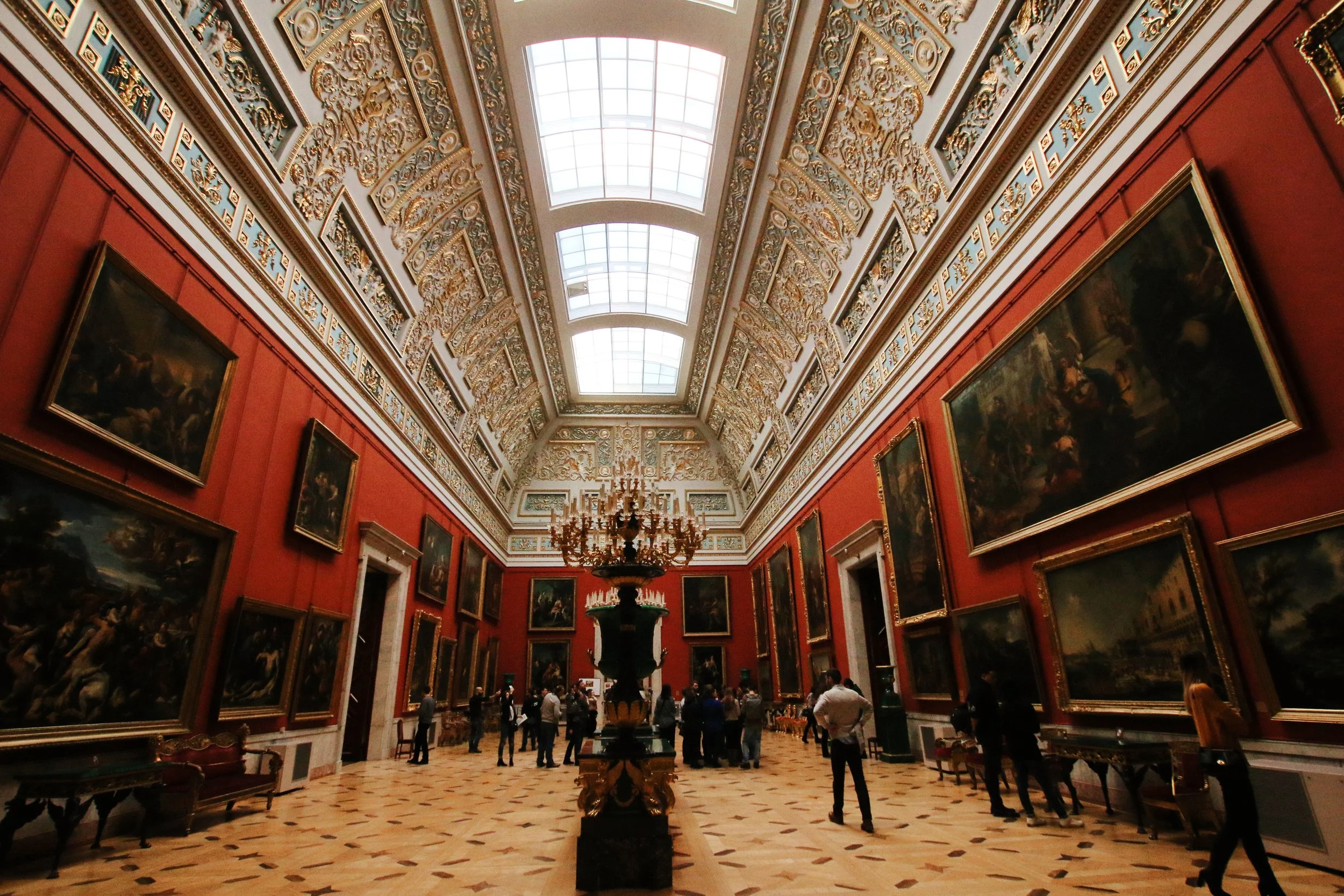
Catherine the Great started buying paintings in bulk in 1764, and the Hermitage never stopped. It now claims about 3 million items across the Winter Palace and connected buildings, and the gilded interiors are themselves part of the show. The Rembrandt holdings are extraordinary, including "The Return of the Prodigal Son," and there's a stunning bloc of early modernism: Matisse's "The Dance," major Picassos, room after room the Soviet state inherited from pre-revolution collectors.
I'll be honest about the present: travel to Russia is complicated and politically fraught right now, and many readers won't be going soon. I'm ranking the collection, which remains one of the half-dozen greatest on earth.
7. Uffizi Gallery, Florence
The Uffizi is small compared to the Louvre, with around 2,000 works on display, but it owns the Italian Renaissance the way the Prado owns Spanish painting. Botticelli's "The Birth of Venus" and "Primavera" hang in the same museum. Leonardo's "Annunciation," Michelangelo's "Doni Tondo," Caravaggio's "Medusa," Titian's "Venus of Urbino": you move through art history in roughly the order it happened.
It gets brutally crowded in summer for the size of the rooms, so book a timed slot. If you want to understand why the Renaissance still anchors how we talk about Western painting, this building is the argument. It connects to a bigger point about why art movements still matter even when you're standing far outside any gallery.
8. Rijksmuseum, Amsterdam
The Rijksmuseum reopened in 2013 after a ten-year renovation, and the rehang was so good it reset expectations for what a national museum can be. The Gallery of Honour funnels you toward Rembrandt's "The Night Watch," displayed at the end of a long nave like the altar of a cathedral. The museum has been restoring that painting in public view, behind glass, which is a smart way to show that conservation is ongoing labor and not magic.
What makes it sing is the Dutch Golden Age in full: Vermeer's "The Milkmaid," Frans Hals portraits, delftware, dollhouses, ship models. It's a museum about a specific people at a specific peak, and that focus makes it feel complete rather than overwhelming.
9. The Museum of Modern Art (MoMA), New York
For everything from roughly 1880 forward, MoMA is the reference collection. Van Gogh's "The Starry Night," Picasso's "Les Demoiselles d'Avignon," Monet's "Water Lilies," Warhol's soup cans, the whole arc of Abstract Expressionism. After its 2019 expansion the museum holds more than 200,000 works and reworked its galleries to mix media and chronology instead of marching through movements in a straight line.
The art and culture site Colossal covers contemporary and emerging work that places like MoMA eventually canonize, which is a useful reminder that today's museum walls are someone's risky bet from decades earlier. If you've ever wondered why abstract art counts as art at all, MoMA is where the case gets made strongest.
10. Musée d'Orsay, Paris
Tenth spot, and I keep it in Paris on purpose because the d'Orsay is the most pleasurable museum to actually spend a day in. It lives inside a converted 1900 railway station, all iron and a great glass clock, and it owns the world's deepest Impressionist and Post-Impressionist collection: Manet's "Olympia," Monet, Renoir, Degas dancers, and the largest single holding of Van Gogh after the dedicated museum in Amsterdam.
It picks up right where the Louvre's collection stops, around 1848, and runs to 1914. The two together make a complete spine of French art. The d'Orsay also proves that human scale beats sheer size; you can see most of it well in an afternoon and leave wanting more rather than numb.
how this list compares to the rankings you'll find online
Most "top 10 museums in the world" lists are really attendance charts. By that measure the Louvre, the Vatican, the Met, and the British Museum dominate because of tourism, and you'll see the Tate Modern and China's National Museum push high too. Wikipedia maintains a regularly updated list of the most-visited art museums if you want raw numbers rather than judgment calls.
Visitor counts measure popularity, not quality. The Frick Collection in New York will never out-draw the Met, but it's one of the most perfect rooms of Old Masters anywhere. Same with the Mauritshuis in The Hague, home to Vermeer's "Girl with a Pearl Earring," a tiny museum punching far above its size. If I were writing a "best small museums" list, both would be near the top.
what about the best modern art museums specifically?
If your interest is strictly post-1900, the ranking shifts. MoMA and the d'Orsay stay, but you'd add Tate Modern in London (free entry, the converted Bankside power station, around 4.7 million visitors a year), the Centre Pompidou in Paris, and the Guggenheim Bilbao, where Frank Gehry's titanium building is as famous as anything inside it. The distinction between "modern" and "contemporary" trips a lot of people up, which is why it's worth reading about the actual difference between the two before you plan a trip around either.
and the best art museums in the U.S.?
Narrowed to America, my order would run the Met, then MoMA, the Art Institute of Chicago (Seurat's "A Sunday on La Grande Jatte" and Hopper's "Nighthawks" in the same building), the National Gallery of Art in Washington (free, with the only Leonardo painting in the Americas), and the Getty in Los Angeles for the collection plus the view. Smithsonian art museums are also free, which matters more than rankings ever admit.
how to actually use a great museum
The mistake almost everyone makes is trying to see everything. You can't, and the trying is what ruins the day. Pick five works before you go, find them first while you're fresh, then wander. A museum is not a checklist. The painting that levels you is usually one you'd never heard of, in a side gallery, when your feet already hurt.
Learning to look helps more than learning facts. The slow-description exercise that Google's "Say What You See" tool is built around works in front of any real painting too: name what's actually there before you reach for what it means. Do that with Velázquez or Vermeer and the famous works stop being postcards and start being arguments somebody won with paint.
One more thing. The greatest object in any of these ten museums is whichever one stops you cold and makes you forget you're tired. For me it was the Goya Black Paintings in the Prado, in a dim room, alone for a minute before a tour group arrived. No ranking put it there. I just couldn't move.