Kerry James Marshall's Art Style, Explained
Kerry James Marshall paints Black life into a Western art history that mostly left it out. His style is deceptively classical and deeply deliberate, here's what's actually going on in those paintings.
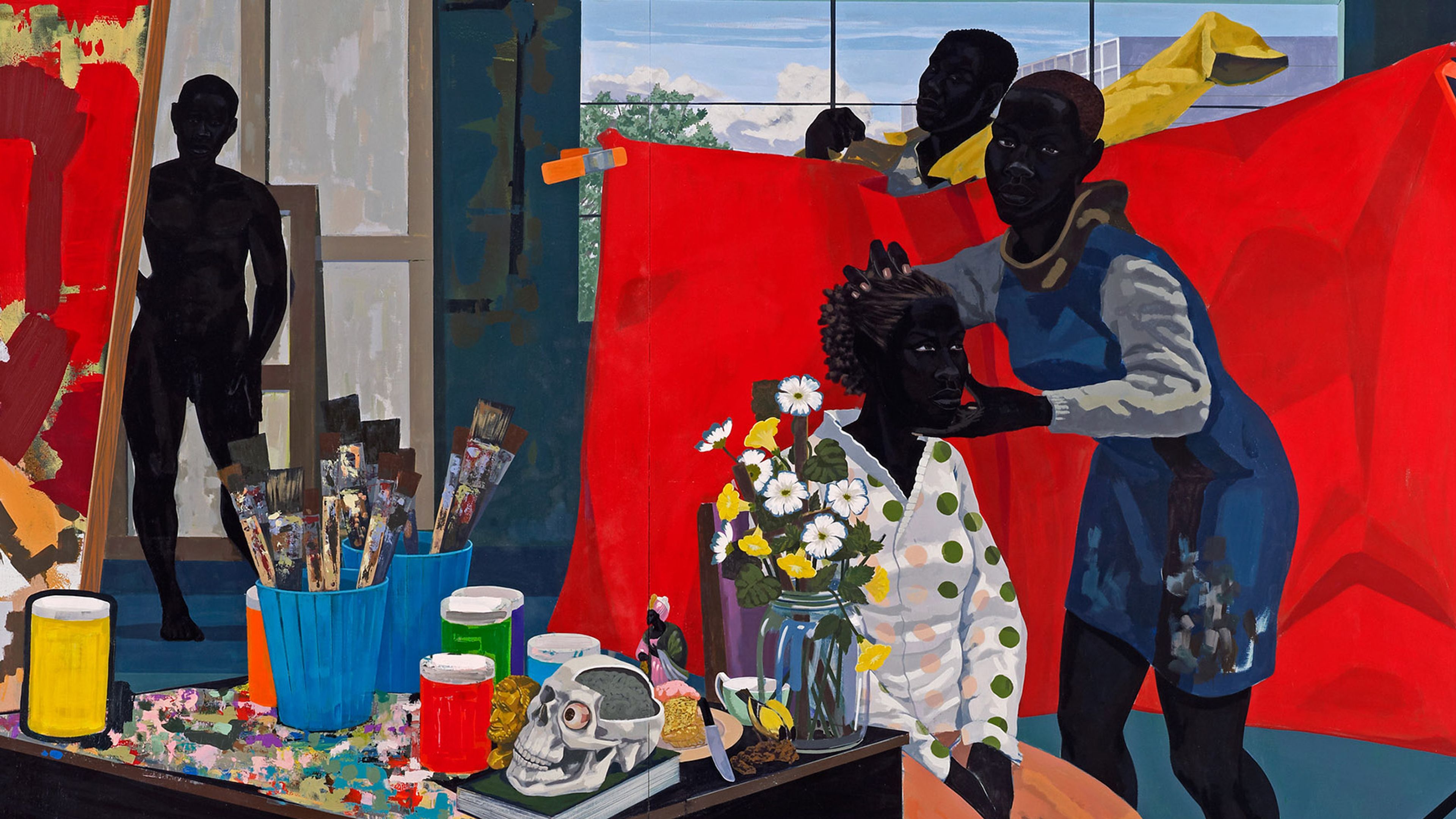
Stand in front of a Kerry James Marshall painting and the first thing you notice is the black. Not dark brown, not shadowy, a flat, emphatic, unmistakable black, the color of the figures' skin rendered in a way no photograph could produce. That choice is the whole argument of his career, and it's the fastest way to understand his style. Marshall isn't painting people who happen to be Black. He's painting blackness as a deliberate, almost confrontational fact, and then surrounding it with all the grandeur Western painting usually reserves for kings, saints, and aristocrats.
So when people ask what Kerry James Marshall's art style is, the honest answer has two halves. Technically, he's a traditionalist, a master of composition, perspective, and the slow craft of oil painting. Conceptually, he's a radical, using that traditional toolkit to insert Black figures into a canon that historically excluded them. The tension between those two halves is the engine of the work.
What was Kerry James Marshall's style of art?
The cleanest label is figurative realism with a history-painting ambition, filtered through a sharp political consciousness. Marshall, born in Birmingham, Alabama in 1955 and raised in the Watts neighborhood of Los Angeles, has spent four decades painting Black domestic life, leisure, beauty, and ceremony at the monumental scale European academies reserved for their most important subjects.
His canvases are large, often mural-sized, sometimes unstretched and pinned to the wall like a tapestry. The scenes are everyday: a barbershop, a beauty parlor, a public housing courtyard, a couple in a garden, a man tending a memorial. But the framing borrows directly from the European old masters. A painting like Past Times (1997) arranges figures on a manicured lawn the way a Watteau or a Seurat might, except the leisure on display belongs to a Black family, and a boombox sits where a lute might have been.
Marshall calls this combination a corrective. He has said plainly that he set out to fill an absence he felt as a young artist, the near-total lack of Black figures in the museums he loved. His style is built to make that absence impossible to ignore.
Why the figures are so black
This is the signature move, and it's worth being precise about. Marshall mixes several black pigments, carbon black, ivory black, Mars black, to build figures whose skin reads as genuinely, almost ideologically black rather than naturalistic brown. The faces are not flat or featureless; look closely and you'll find subtle shifts in tone, the gleam of an eye, the highlight on a lip. But from across the room, the blackness is total and unapologetic.
He's described this partly as a reclamation of the word "black" itself, turning a term once used as an insult into something rich and luminous. It also creates a visual problem he clearly enjoys solving: how do you give a black-on-black figure depth, weight, and presence? The answer is endless tonal subtlety, which rewards anyone willing to stand and look for more than a few seconds. If you want to practice that kind of slow, attentive looking, our guide to is a useful warm-up before visiting his work in person.
What kind of paint does Kerry James Marshall use?
Mostly acrylic, and this surprises people who assume the old-master look requires oils. Marshall favors acrylic on canvas, and frequently on unprimed canvas he tacks directly to the wall, because it dries fast, lets him build flat fields of color, and suits the graphic, almost poster-like clarity he wants. He works in layers, glazing and adjusting, but the medium gives the surfaces a matte, even quality rather than the buttery glow of oil.
That said, he is not a purist. Marshall mixes media freely. His paintings can incorporate collage elements, glitter, stamped or stenciled text, drips, and decorative flourishes that nod to comic books, sign painting, and African American craft traditions like quilting. He'll set a meticulously rendered figure against a passage of pure abstraction or a band of glittering color, reminding you that you're looking at a constructed image, not a window onto reality.
Quick technical summary: Acrylic on canvas, often unstretched; carbon, ivory, and Mars black pigments built up in layers; mixed-media additions (glitter, collage, stamped text); compositions modeled on European history painting and genre scenes.
The materials matter because they're part of the message. Acrylic is democratic, cheaper, faster, less precious than oil. Glitter and decorative pattern carry associations with Black popular culture and domestic decoration. Marshall is fluent in the hierarchy that treats oil-on-canvas as "high" art and everything else as lesser, and he cheerfully ignores it.
Kerry James Marshall's most famous paintings
A few works anchor his reputation, and they're a good map of his range:
- A Portrait of the Artist as a Shadow of His Former Self (1980), A small, early breakthrough. A nearly all-black figure dissolves into a black background, with only eyes, teeth, and a white shirt emerging. It's where the signature blackness first crystallized.
- The Garden Project series (1994–95), Large paintings of life in public housing developments with idyllic-sounding names like "Wentworth Gardens" and "Nickerson Gardens," painting dignity and beauty into spaces popular culture treated as nothing but blight.
- De Style (1993), A barbershop scene, both a pun on the De Stijl movement and a portrait of a Black social institution rendered with the formality of a group portrait by an old master.
- Past Times (1997), The leisure scene mentioned above, and the painting that set his auction record.
- School of Beauty, School of Culture (2012), A dazzling beauty-salon interior that hides a distorted blonde figure (a Disney-princess reference) in the floor, smuggling a quiet point about whose beauty standards dominate.
If you find yourself drawn to the stories embedded in these works, you're really responding to the same impulse that makes the backstories of famous paintings so compelling, Marshall packs his canvases with references that reward unpacking.
How much are Kerry James Marshall paintings worth?
A great deal, and the trajectory has been steep. The watershed moment came in May 2018, when Past Times sold at Sotheby's in New York for $21.1 million, at the time a record for a living African American artist. The buyer was the rapper and entrepreneur Sean Combs. The painting had originally been bought by the Metropolitan Pier and Exposition Authority in Chicago in 1997 for about $25,000, which gives you a sense of how dramatically the market caught up to him.
That sale wasn't a fluke. Marshall's major paintings now regularly command seven and eight figures when they appear at auction, which is rare because most of his significant works are already in museum collections, including the Met, MoMA, the Art Institute of Chicago, and the National Gallery of Art. Scarcity drives the prices further up.
What about prints and more affordable work?
If a multimillion-dollar canvas is out of reach, and for nearly everyone, it is, Marshall has produced limited-edition prints and editioned works that trade in the tens of thousands of dollars, still serious money but a different universe from the paintings. Genuine, signed Marshall editions are sought after and not cheap, so be cautious about anything advertised as "Kerry James Marshall art for sale" at suspiciously low prices; the market has plenty of unauthorized reproductions and posters that carry no value as collectibles. For a realistic sense of how to build a collection without a celebrity budget, our piece on starting an art collection for real money is a better starting point than chasing a blue-chip name you can't afford.
Who is Kerry James Marshall inspired by?
Marshall is unusually open about his influences, and they fall into two camps that mirror his style's double nature.
On the technical side, he reveres the European tradition: the Renaissance and Baroque masters, Hans Holbein's precision, the genre scenes of the Dutch Golden Age, the grand history painting of the French academy, and the modern formal innovations of artists like Seurat. He studied this canon obsessively and built his craft to match it. He has spoken admiringly of the sheer competence of the old masters, the idea that to challenge a tradition convincingly, you first have to be able to out-paint it.
On the conceptual and cultural side, his lodestar is the experience of growing up Black in America during the civil rights era and its aftermath. He's cited the influence of the photographer and curator who showed him what an art career could look like, the visual culture of Black Los Angeles, African American history, and writers and thinkers grappling with identity and representation. The work of earlier Black American artists, and his determination not to let their relative invisibility repeat, sits underneath everything.
Crucially, Marshall is also responding to the entire history of art movements as a system that decided who counts. His paintings argue with abstraction, with history painting, with modernism, sometimes all in one canvas. That's part of why his work is so satisfying once you know a little about the movements he's quoting and resisting; understanding why art movements still matter turns his references from background noise into a running conversation you can follow.
Why his style lands so hard right now
Marshall's work has become a reference point for a whole generation of figurative painters depicting Black life, and the art press has tracked that influence closely. The arts publication Colossal, in its ongoing coverage of contemporary figurative painting, is one of many outlets that have charted how a once-marginal approach to representation became central to the conversation.
What makes his style durable isn't just the politics, though. It's that the politics and the craft are inseparable. A lesser artist might paint a Black subject in a grand setting and call it a statement; Marshall makes you feel the statement through composition, color, scale, and the slow pleasure of looking. The blackness of the figures isn't a gimmick laid over good painting, it is the good painting, the thing every other decision serves.
And there's an invitation in it, too. Marshall has always insisted that anyone can learn to see and even make this kind of work; mastery is built, not given. That's a generous idea, and it connects to something we keep coming back to here, the notion that creativity is more available to ordinary people than the museum mystique suggests, a point we make in our argument that you're more of an artist than you think.
The short version
Kerry James Marshall's art style is figurative, classically composed, technically rigorous painting, usually in acrylic on large canvases, built around emphatically black figures and scenes of Black American life. He uses the formal language of European old-master painting to claim space in a tradition that excluded people who looked like him, and he does it with enough skill that the work succeeds as painting first and argument second. That combination is why a canvas he might once have sold for the price of a used car now hangs in the world's great museums and trades for tens of millions. Once you've seen the black, you can't unsee the point.